


碳纤维增强碳化硅mini复合材料超高温塑性本构关系实验和理论研究
doi: 10.21656/1000-0887.460072
Ultra-High-Temperature Plastic Constitutive Relations of Carbon Fiber Reinforced Silicon Carbide Minicomposites: Experiment and Modeling
-
摘要: 先进的陶瓷基复合材料具有耐超高温、抗腐蚀、高的比强度和高的比刚度等优异性能,是新一代高超声速飞行器热防护材料和结构的重要候选材料. 然而,陶瓷基复合材料复杂的微观结构和多种损伤机制使其本构研究面临诸多挑战. Mini复合材料是多尺度研究中的重要桥梁,研究其力学性能对先进陶瓷基复合材料的研发和服役安全可靠性评价具有重要意义. 基于间接感应加热技术,首次开展了惰性环境2 200 ℃下C/PyC/SiC mini复合材料拉伸性能测试,揭示了陶瓷基复合材料在服役超高温极端环境下的塑性变形行为. 采用三参数Weibull概率统计模型表征基体的随机开裂,通过剪滞模型计算纤维和基体中的应力分布,考虑纤维束的超高温非线性变形和残余热应力影响,建立了C/PyC/SiC mini复合材料超高温塑性细观本构模型,并将理论预测结果和实验结果对比,对模型进行了验证. 该研究不仅能够丰富陶瓷基复合材料的力学理论体系,还将为其在高超声速飞行器上的服役可靠性评估和寿命预测提供实验和理论支撑.Abstract: Advanced ceramic matrix composites have excellent properties, such as resistance to ultra-high temperatures and corrosion, as well as high specific strength and stiffness. They are important candidates for thermal protection materials and structures of new-generation hypersonic vehicles. However, ceramic matrix composites have complex microstructures and various damage mechanisms, which make the study of their constitutive relations challenging. Minicomposites are the critical link in the multi-scale study of ceramic matrix composites. The study on their mechanical behaviors is important to the development and evaluation of security and reliability of advanced ceramic matrix composites. The tensile properties of C/PyC/SiC minicomposites were measured at 2 200 ℃ in inert atmospheres for the first time based on the indirect induction heating technology. The plastic deformation behaviors of ceramic matrix composites under ultra-high-temperature extreme environments were revealed. The random cracking of matrix was characterized by a 3-parameter Weibull model. The stress distributions of fiber and matrix were calculated based on the slip-lag model. The effects of ultra-high-temperature nonlinear deformation of fiber bundles and residual thermal stresses in the composites were characterized. An ultra-high-temperature plastic mesoscale constitutive model was established for C/PyC/SiC minicomposites and verified. The study is useful for the development of mechanics for ceramic matrix composites and provides experimental and theoretical supports for the reliability evaluation and life prediction of ceramic matrix composites on the hypersonic vehicles.
-
Key words:
- ceramic matrix composite /
- ultra-high-temperature extreme environment /
- plastic constitutive
edited-byedited-by1) (我刊编委陈立明来稿) -

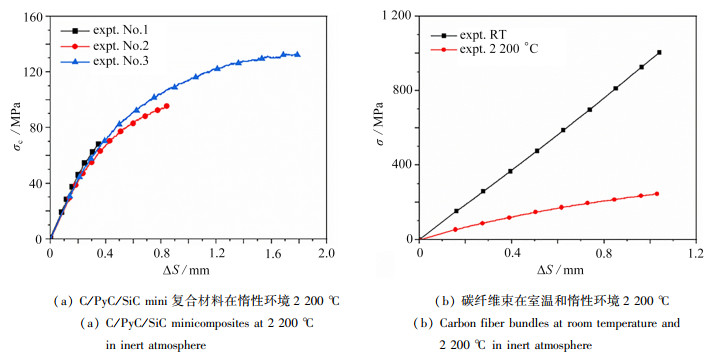
图 3 实验测得的拉伸应力-变形曲线
注 为了解释图中的颜色,读者可以参考本文的电子网页版本,后同.
Figure 3. Tensile stress-deformation curves measured experimentally

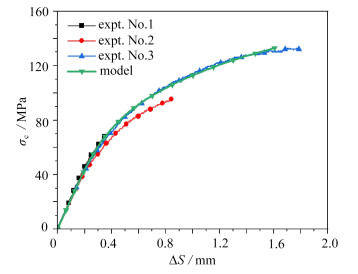
图 5 理论预测得到的C/PyC/SiC mini复合材料惰性环境2 200 ℃时的拉伸应力-变形曲线和实验结果的对比
Figure 5. Comparison between the tensile stress-deformation curves of C/PyC/SiC minicomposites at 2 200 ℃ in inert atmosphere calculated by theory and measured by experiment

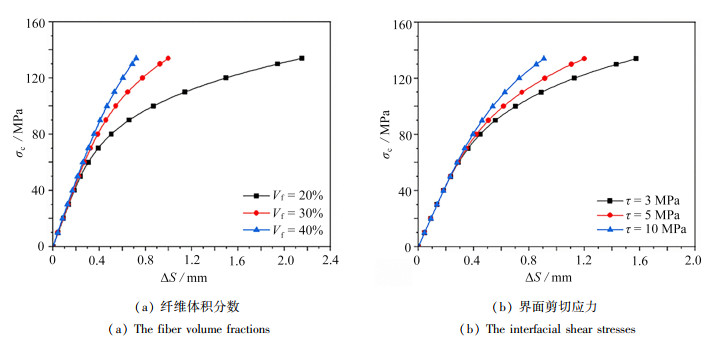
图 6 不同变量对C/PyC/SiC mini复合材料惰性环境2 200 ℃时的拉伸应力-变形行为的影响
Figure 6. Effects of different factors on the tensile stress-deformation behaviors of C/PyC/SiC minicomposites at 2 200 ℃ in inert atmosphere
表 1 计算所用材料参数
Table 1. Material parameters used in the calculations
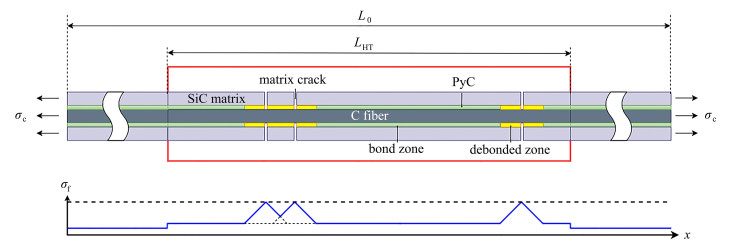
parameter value parameter value L0/mm 200 LHT/mm 60 Vf/% 23 Vm/% 77 rf/μm 3.5 EfRT/GPa 211 EmRT/GPa 276 Em(2 200 ℃)/GPa 16 αm(2 200 ℃)/(10-6 /℃) 4.50 αf(2 200 ℃)/(10-6 /℃) 2.56 τ(2 200 ℃)/MPa 3 k1/(10-3·mm·MPa-1) 1.06 a/(10-3·mm·MPa-2) 6.01 b/(10-3·mm·MPa-1) 2.50 T/℃ 2 200 Tp/℃ 1 000 Cp/(10-3·mm·N-1) 2.90 σb/MPa 10 m0 5 Lb/m 1  下载: 导出CSV
-
[1] 李卫国, 成天宝, 张如炳, 等. 应力降低因子和陶瓷材料抗热冲击阻力参数的性质及适用条件[J]. 应用数学和力学, 2012, 33(11): 1257-1265. doi: 10.3879/j.issn.1000-0887.2012.11.001LI Weiguo, CHENG Tianbao, ZHANG Rubing, et al. Properties and appropriate conditions of stress reduction factor and thermal shock resistance parameters for ceramics[J]. Applied Mathematics and Mechanics, 2012, 33(11): 1257-1265. (in Chinese) doi: 10.3879/j.issn.1000-0887.2012.11.001 [2] CHENG T, LI W, FANG D. Thermal shock resistance of ultra-high-temperature ceramics under aerodynamic thermal environments[J]. AIAA Journal, 2013, 51(4): 840-848. doi: 10.2514/1.J051750 [3] 常宛云, 崔红, 邓红兵, 等. C/C-SiC复合材料制备技术及其在航空航天领域的应用[J]. 炭素, 2015(4): 11-17.CHANG Wanyun, CUI Hong, DENG Hongbing, et al. Fabrication of C/C-SiC composite and its applications in aerospace field[J]. Carbon, 2015(4): 11-17. (in Chinese) [4] 刘巧沐, 黄顺洲, 何爱杰. 碳化硅陶瓷基复合材料在航空发动机上的应用需求及挑战[J]. 材料工程, 2019, 47(2): 1-10.LIU Qiaomu, HUANG Shunzhou, HE Aijie. Application requirements and challenges of CMC-SiC composites on aero-engine[J]. Journal of Materials Engineering, 2019, 47(2): 1-10. (in Chinese) [5] 杜昆, 陈麒好, 孟宪龙, 等. 陶瓷基复合材料在航空发动机热端部件应用及热分析研究进展[J]. 推进技术, 2022, 43(2): 107-125.DU Kun, CHEN Qihao, MENG Xianlong, et al. Advancement in application and thermal analysis of ceramic matrix composites in aeroengine hot components[J]. Journal of Propulsion Technology, 2022, 43(2): 107-125. (in Chinese) [6] PETERS A B, ZHANG D, CHEN S, et al. Materials design forhypersonics[J]. Nature Communications, 2024, 15: 3328. doi: 10.1038/s41467-024-46753-3 [7] 张永正, 刘磊, 刘琦, 等. C/SiC编织型复合材料热/力学性能的多尺度预测[J]. 应用数学和力学, 2023, 44(10): 1157-1171. doi: 10.21656/1000-0887.440056ZHANG Yongzheng, LIU Lei, LIU Qi, et al. Multi-scale prediction of thermal and mechanical properties of C/SiC braided composites[J]. Applied Mathematics and Mechanics, 2023, 44(10): 1157-1171. (in Chinese) doi: 10.21656/1000-0887.440056 [8] CHEN X, SUN Z, NIU X, et al. In situ investigation of tensile behavior of Cf/SiC mini composites[J]. International Journal of Applied Ceramic Technology, 2021, 18(5): 1677-1690. [9] NAGARAJA A M, GURURAJA S, UDAYAKUMAR A. Tensile behavior of ceramic matrix minicomposites with engineered interphases fabricated by chemical vapor infiltration[J]. Journal of the European Ceramic Society, 2022, 42(6): 2659-2671. doi: 10.1016/j.jeurceramsoc.2022.01.047 [10] ZHAO D, GUO T, FAN X, et al. Effect of pyrolytic carbon interphase on mechanical properties of mini T800-C/SiC composites[J]. Journal of Advanced Ceramics, 2021, 10(2): 219-226. [11] SOLTI J P, MALL S, ROBERTSON DD. Modeling damage in unidirectional ceramic-matrix composites[J]. Composites Science and Technology, 1995, 54(1): 55-66. doi: 10.1016/0266-3538(95)00041-0 [12] ZHANG S, GAO X, CHEN J, et al. Strength model of the matrix element in SiC/SiC composites[J]. Materials & Design, 2016, 101: 66-71. [13] LI J, LIU J, WANG B, et al. Tensile damage evolution of unidirectional ceramic matrix composites under thermal stress[J]. Ceramics International, 2024, 50(21): 43500-43512. doi: 10.1016/j.ceramint.2024.08.201 [14] SAUDER C, LAMON J, PAILLER R. The tensile behavior of carbon fibers at high temperatures up to 2 400 ℃[J]. Carbon, 2004, 42(4): 715-725. doi: 10.1016/j.carbon.2003.11.020 [15] CHENG T. Ultra-high-temperature mechanical behaviors of two-dimensional carbon fiber reinforced silicon carbide composites: experiment and modeling[J]. Journal of the European Ceramic Society, 2021, 41(4): 2335-2346. [16] CURTIN W A, AHN B K, TAKEDA N. Modeling brittle and tough stress-strain behavior in unidirectional ceramic matrix composites[J]. Acta Materialia, 1998, 46(10): 3409-3420. doi: 10.1016/S1359-6454(98)00041-X [17] AHN B K, CURTIN W A. Strain and hysteresis by stochastic matrix cracking in ceramic matrix composites[J]. Journal of the Mechanics and Physics of Solids, 1997, 45(2): 177-209. [18] CHATEAU C, GÉLÉBART L, BORNERT M, et al. Modeling of damage in unidirectional ceramic matrix composites and multi-scale experimental validation on third generationSiC/SiC minicomposites[J]. Journal of the Mechanics and Physics of Solids, 2014, 63: 298-319. [19] PRYCE A W, SMITH P A. Matrix cracking in unidirectional ceramic matrix composites under quasi-static and cyclic loading[J]. Acta Metallurgica et Materialia, 1993, 41(4): 1269-1281. [20] GOLDBERG R K, ALMANSOUR A S, SULLIVAN R M. Analytical simulation of effects of local mechanisms on tensile response of ceramic matrix minicomposites[J]. Journal of the European Ceramic Society, 2022, 42(15): 6846-6864. -

计量
- 文章访问数: 53
- HTML全文浏览量: 11
- PDF下载量: 21
- 被引次数: 0

 渝公网安备50010802005915号