


Residual Splitting Adaptive Physics-Informed Neural Networks for Solving Partial Differential Equations
-
摘要: 物理信息神经网络(PINN)损失函数之间的量级差异,导致训练过程收敛缓慢,有时甚至会在某些区域训练失败.为解决这一挑战,本文提出了一种融合残差分裂和权重自适应的PINN模型.该方法通过将主导PINN训练过程的偏微分方程(PDE)残差项,按照区域分解的方式分裂为多个独立子项,并采用权重自适应加权策略,自动调节各个子项之间的权重,从而改善了PINN的收敛性.该方法弥补了全局残差策略忽略和抹平局部特征的缺陷,通过分裂子项的方式增加了对局部特征的关注,改善了优化过程的效率,从而提升了求解精度.数值实验结果表明,本文方法不仅在精度上超越了现有几种模型,且达到了2~3个数量级的提升,计算效率也表现出优越性能.Abstract: The magnitude difference between the loss functions of physical-informed neural networks (PINN) leads to a slow convergence of the training process and sometimes even training failure in some regions. To address this challenge, a physical-informed neural network model incorporating residual splitting and weight self-adaptation was proposed. The method improves the convergence of PINN by splitting the residual terms of PDE dominating the training process of PINN, into multiple independent components according to the domain decomposition, and adopts a self-adaptive weighting strategy to automatically adjust the weights among the components, thus promoting the convergence of PINN. This method makes up for the defects of the global residual strategy ignoring and smoothing out the local features, and increases the attention to the local features by splitting the subterms, which improves the efficiency of the optimization process, and thus enhances the solution accuracy. Through numerical experiments, the results show that, the proposed method not only surpasses the existing models in terms of accuracy, but also achieves an improvement of 2-3 orders of magnitude with superior computational efficiency.
-

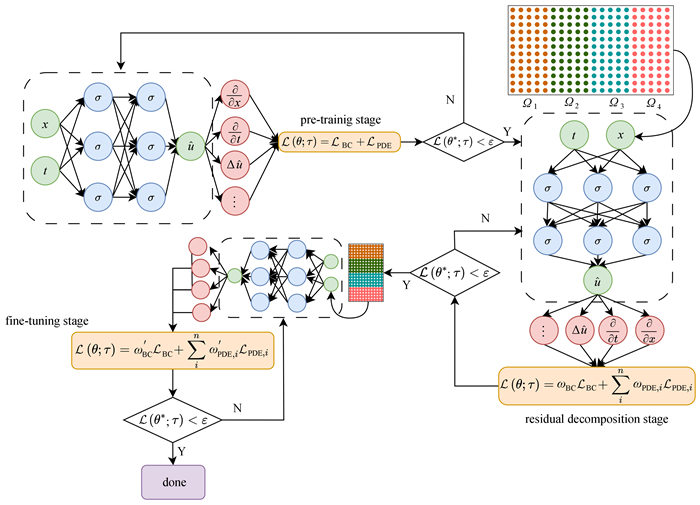
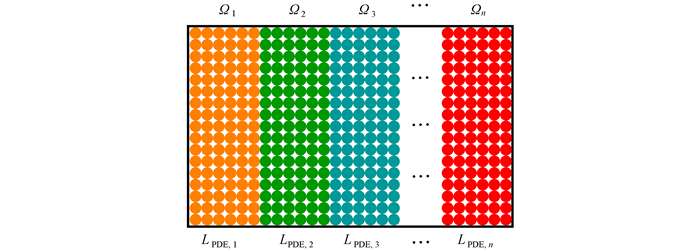
图 1 区域分裂后各区域表示情况
Figure 1. The situation expressed by each region after regional division

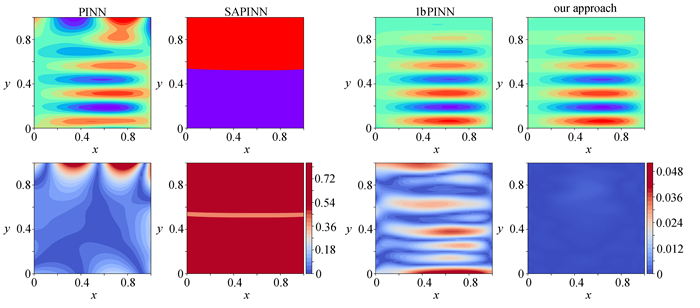
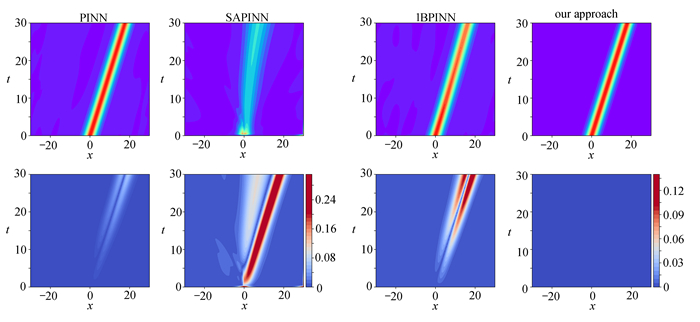
图 4 四种不同方法的预测解和误差分布
注 为了解释图中的颜色,读者可以参考本文的电子网页版本,后同.
Figure 4. Predicted solutions and error distributions for 4 different methods

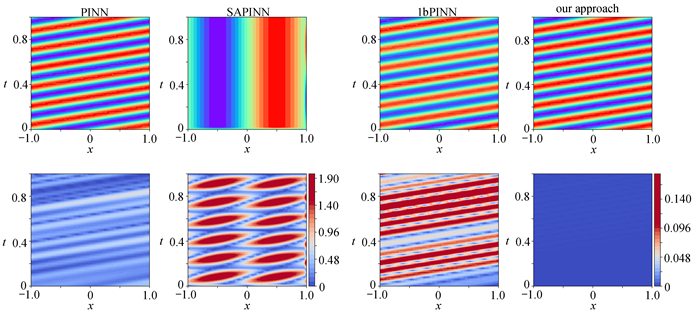
图 6 四种不同方法的预测解和误差分布
Figure 6. Predicted solutions and error distributions for 4 different methods

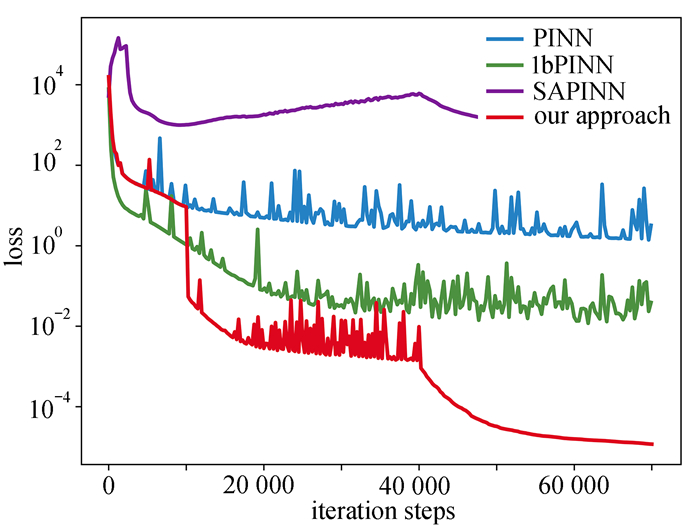
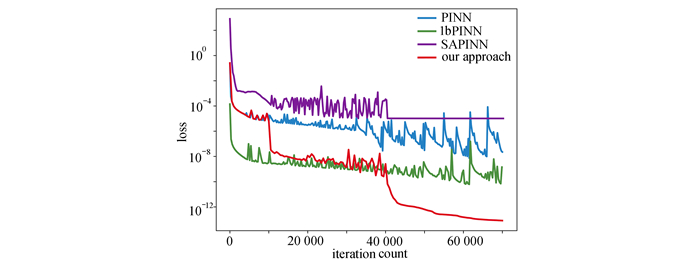
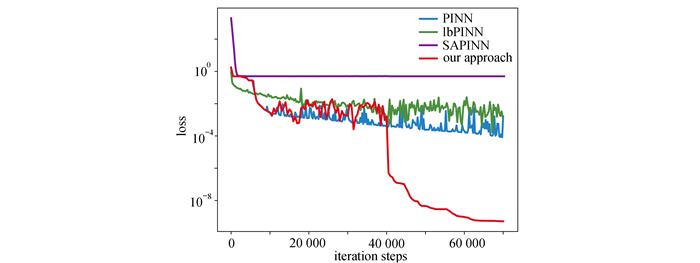
图 7 不同方法的损失函数误差收敛图
Figure 7. Error convergence curves of the loss functions for different methods

图 8 四种方法的预测解和误差分布
Figure 8. Predicted solutions and error distributions for the 4 methods

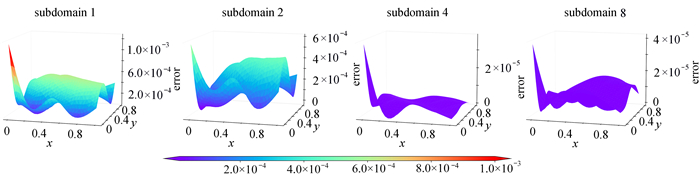
图 9 不同区域分裂策略下预测解u(x, y, 0, 2)的误差对比
Figure 9. Comparison of prediction errors of solution u(x, y, 0, 2) under different regional division strategies
表 1 算例1在不同频率下的误差、训练时间
Table 1. Errors and training times at different frequencies for example 1
method ω subdomain eloss e2 e∞ training time/s PINN 15 - 6.92E-2 7.64E-2 8.14E-2 190.63 20 - 7.40E-1 3.00E-1 1.86E-1 189.02 25 - 3.26 8.75E-1 8.13E-1 195.78 lbPINN 15 - 1.58E-2 1.55E-2 1.57E-2 180.67 20 - 9.34E-3 1.82E-2 1.83E-2 199.56 25 - 2.63E-2 9.41E-2 5.20E-2 210.10 SAPINN 15 - 6.12 3.76 1.78 1 554.46 20 - 2.85E-1 4.20 2.89 1 499.22 25 - 6.84E-2 6.59E-1 2.10E-1 1 514.71 our approach 15 (3, 1) 7.34E-7 8.03E-4 7.84E-4 196.52 20 (3, 1) 2.49E-6 1.20E-3 8.41E-4 180.71 25 (3, 1) 1.17E-5 3.45E-3 2.29E-3 196.85  下载: 导出CSV
表 2 不同残差分裂策略的误差
Table 2. Errors of different residual splitting strategies
method ω subdomain eloss e2 e∞ training time/s our approach 25 (1, 1) 1.57E-4 3.59E-2 2.02E-2 202.11 (3, 1) 1.17E-5 3.45E-3 2.29E-3 196.85 (5, 1) 8.84E-5 4.87E-3 5.34E-3 212.77 (3, 2) 1.07E-4 3.55E-3 1.19E-3 199.49 (3, 3) 4.72E-4 2.10E-2 1.90E-2 217.94
下载: 导出CSV
表 3 在不同波速情况下四种方法误差、时间对比
Table 3. Comparison of errors and times of 4 methods under different wave speeds
method λ subdomain eloss e2 e∞ training time/s PINN 0.2 - 2.07E-8 3.78E-2 5.81E-3 109.72 0.4 - 1.12E-6 3.90E-1 1.14E-1 111.06 0.6 - 2.25E-8 5.34E-2 3.20E-2 114.39 lbPINN 0.2 - 1.20E-11 3.01E-2 4.08E-3 117.08 0.4 - 2.19E-11 5.35E-2 2.04E-2 123.77 0.6 - 6.66E-11 2.72E-1 1.36E-1 146.07 SAPINN 0.2 - 9.39E-6 1.80E-2 3.37E-3 981.95 0.4 - 1.60E-6 8.82E-3 2.76E-3 962.94 0.6 - 1.02E-5 8.93E-1 2.96E-1 1019.10 our approach 0.2 (5, 1) 5.74E-16 1.52E-5 1.54E-6 103.90 0.4 (5, 1) 1.34E-13 9.01E-5 2.94E-5 101.15 0.6 (5, 1) 8.18E-14 9.10E-5 4.28E-5 103.82
下载: 导出CSV
表 4 四种方法在不同扩散速率下的各种误差与训练时间
Table 4. Various errors vs. training times for the 4 methods at different diffusion rates
method λ subdomain eloss e2 e∞ training time/s PINN 8 - 3.78E-5 1.02E-2 1.86E-2 109.72 10 - 9.84E-3 7.80E-2 1.38E-1 111.06 12 - 1.63E-3 3.11E-2 5.27E-2 114.39 lbPINN 8 - 7.39E-3 1.12E-2 2.22E-2 117.08 10 - 1.76E-3 4.61E-2 8.38E-2 123.77 12 - 5.50E-3 1.16E-1 1.83E-1 146.07 SAPINN 8 - 4.51E-1 1.36 1.99 778.91 10 - 4.51E-1 1.36 1.99 773.56 12 - 4.51E-1 1.36 1.99 775.83 our approach 8 (2, 2) 4.67E-10 7.75E-4 1.61E-3 103.90 10 (2, 2) 9.29E-9 3.76E-3 5.50E-3 101.15 12 (2, 2) 5.09E-10 9.31E-4 1.58E-3 103.82
下载: 导出CSV
表 5 不同时间区域的不同分裂策略误差对比
Table 5. Comparison of different splitting strategies' errors in different time domain
method T=1 s T=2 s subdomain e2 e∞ training time/s subdomain e2 e∞ training time/s PINN - 7.92E-4 8.24E-3 223.56 - 6.92E-4 3.49E-3 205.89 lbPINN - 6.54E-4 6.85E-3 210.66 - 5.86E-4 3.79E-3 189.19 our approach 1 0.67E-5 9.66E-4 198.67 1 9.18E-4 1.10E-3 188.98 2 8.86E-6 7.29E-5 158.82 2 8.64E-5 5.44E-4 191.56 4 1.15E-5 1.38E-4 165.73 4 8.18E-6 4.44E-5 229.71 8 1.23E-5 6.60E-5 248.29 8 1.22E-5 8.09E-5 252.92
下载: 导出CSV
-
[1] ZHANG S, GU W, ZHANG X P, et al. Dynamic modeling and simulation of integrated electricity and gas systems[J]. IEEE Transactions on Smart Grid, 2023, 14 (2): 1011-1026. doi: 10.1109/TSG.2022.3203485 [2] AVALOS G, LASIECKA I, TRIGGIANI R. Heat-wave interaction in 2/3 dimensions: optimal rational decay rate[J]. Journal of Mathematical Analysis and Applications, 2016, 437 (2): 782-815. doi: 10.1016/j.jmaa.2015.12.051 [3] ARQUB O A. Numerical solutions for the Robin time-fractional partial differential equations of heat and fluid flows based on the reproducing kernel algorithm[J]. International Journal of Numerical Methods for Heat & Fluid Flow, 2018, 28 (4): 828-856. [4] ZHANG Y. A finite difference method for fractional partial differential equation[J]. Applied Mathematics and Computation, 2009, 215 (2): 524-529. doi: 10.1016/j.amc.2009.05.018 [5] QIN X Q, MA Y C, ZHANG Y. Two-grid method for characteristics finite-element solution of 2D nonlinear convection-dominated diffusion problem[J]. Applied Mathematics and Mechanics, 2005, 26 (11): 1506-1514. doi: 10.1007/BF03246258 [6] EYMARD R, GALLOUËT T, HERBIN R. Handbook of Numerical Analysis: Finite Volume Methods[M]. Elsevier, 2000, 7 : 713-1018. [7] NOCHETTO R H, SIEBERT K G, VEESER A. Theory of adaptive finite element methods: an introduction[C]//Multiscale, Nonlinear and Adaptive Approximation. Berlin, Heidelberg: Springer, 2009: 409-542. [8] RASP S, PRITCHARD M S, GENTINE P. Deep learning to represent subgrid processes in climate models[J]. Proceedings of the National Academy of Sciences, 2018, 115 (39): 9684-9689. doi: 10.1073/pnas.1810286115 [9] LENG K, NISSEN-MEYER T, VAN DRIEL M, et al. AxiSEM3D: broad-band seismic wavefields in 3-D global earth models with undulating discontinuities[J]. Geophysical Journal International, 2019, 217 (3): 2125-2146. doi: 10.1093/gji/ggz092 [10] RAISSI M, PERDIKARIS P, KARNIADAKIS G E. Physics-informed neural networks: a deep learning framework for solving forward and inverse problems involving nonlinear partial differential equations[J]. Journal of Computational Physics, 2019, 378 : 686-707. doi: 10.1016/j.jcp.2018.10.045 [11] LU L, MENG X, MAO Z, et al. DeepXDE: a deep learning library for solving differential equations[J]. SIAM Review, 2021, 63 (1): 208-228. doi: 10.1137/19M1274067 [12] SUN L, GAO H, PAN S, et al. Surrogate modeling for fluid flows based on physics-constrained deep learning without simulation data[J]. Computer Methods in Applied Mechanics and Engineering, 2020, 361 : 112732. doi: 10.1016/j.cma.2019.112732 [13] ARZANI A, WANG J X, D'SOUZA R M. Uncovering near-wall blood flow from sparse data with physics-informed neural networks[J]. Physics of Fluids, 2021, 33 (7): 071905. doi: 10.1063/5.0055600 [14] WANG Y, BAI J, LIN Z, et al. Artificial intelligence for partial differential equations in computational mechanics: a review[PP/OL]. arXiv(2024-11-23)[2025-03-24]. https://arxiv.org/abs/2410.19843v2 .[15] WU H, LUO H, MA Y, et al. RoPINN: region optimized physics-informed neural networks[PP/OL]. arXiv(2024-10-23)[2025-03-24]. https://arxiv.org/abs/2405.14369v3 .[16] JAGTAP A D, KARNIADAKIS G E. Extended physics-informed neural networks (XPINNs): a generalized space-time domain decomposition based deep learning framework for nonlinear partial differential equations[J]. Communications in Computational Physics, 2020, 28 (5): 2002-2041. doi: 10.4208/cicp.OA-2020-0164 [17] WIGHT C L, ZHAO J. Solving Allen-cahn and cahn-Hilliard equations using the adaptive physics informed neural networks[J]. Communications in Computational Physics, 2021, 29 (3). [18] WANG Y, YAO Y, GUO J, et al. A practical PINN framework for multi-scale problems with multi-magnitude loss terms[J]. Journal of Computational Physics, 2024, 510 : 113112. doi: 10.1016/j.jcp.2024.113112 [19] WANG S, YU X, PERDIKARIS P. When and why PINNs fail to train: a neural tangent kernel perspective[J]. Journal of Computational Physics, 2022, 449 : 110768. doi: 10.1016/j.jcp.2021.110768 [20] ELHAMOD M, BU J, SINGH C, et al. CoPhy-PGNN: learning physics-guided neural networks with competing loss functions for solving eigenvalue problems[J]. ACM Transactions on Intelligent Systems and Technology, 2022, 13 (6): 1-23. [21] WANG S, TENG Y, PERDIKARIS P. Understanding and mitigating gradient flow pathologies in physics-informed neural networks[J]. SIAM Journal on Scientific Computing, 2021, 43 (5): A3055-A3081. doi: 10.1137/20M1318043 [22] SONG Y, WANG H, YANG H, et al. Loss-attentional physics-informed neural networks[J]. Journal of Computational Physics, 2024, 501 : 112781. doi: 10.1016/j.jcp.2024.112781 [23] QIU L, WANG Y, GU Y, et al. Adaptive physics-informed neural networks for dynamic coupled thermo-mechanical problems in large-size-ratio functionally graded materials[J]. Applied Mathematical Modelling, 2025, 140 : 115906. doi: 10.1016/j.apm.2024.115906 [24] YANG J, LIU X, DIAO Y, et al. Adaptive task decomposition physics-informed neural networks[J]. Computer Methods in Applied Mechanics and Engineering, 2024, 418 : 116561. [25] XIANG Z, PENG W, LIU X, et al. Self-adaptive loss balanced physics-informed neural networks[J]. Neurocomputing, 2022, 496 : 11-34. [26] MCCLENNY L, BRAGA-NETO U. Self-adaptive physics-informed neural networks using a soft attention mechanism[PP/OL]. arXiv(2024-06-18)[2025-03-24]. https://arxiv.org/abs/2009.04544v5 .[27] KINGMA D P, BA J. Adam: a method for stochastic optimization[PP/OL]. arXiv(2017-01-30)[2025-03-24]. https://arxiv.org/abs/1412.6980v9 .[28] BYRD R H, LU P, NOCEDAL J, et al. A limited memory algorithm for bound constrained optimization[J]. SIAM Journal on Scientific Computing, 1995, 16 (5): 1190-1208. [29] WANG Y, LAI C Y. Multi-stage neural networks: function approximator of machine precision[J]. Journal of Computational Physics, 2024, 504 : 112865. [30] 闵建, 傅卓佳, 郭远. 课程-迁移学习物理信息神经网络用于曲面长时间对流扩散行为模拟[J]. 应用数学和力学, 2024, 45 (9): 1212-1223. doi: 10.21656/1000-0887.440320 MIN Jian, FU Zhuojia, GUO Yuan. Curriculum-transfer-learning-based physics-informed neural networks for simulating long-term-evolution convection-diffusion behaviors on curved surfaces[J]. Applied Mathematics and Mechanics, 2024, 45 (9): 1212-1223. (in Chinese) doi: 10.21656/1000-0887.440320 -

计量
- 文章访问数: 63
- HTML全文浏览量: 16
- PDF下载量: 21
- 被引次数: 0

 渝公网安备50010802005915号