


Functionally Graded Extended Isogeometric Material Distribution Optimization Based on the Simple First-Order Shear Deformation Theory
-
摘要: 在实际工程应用中,解决质量优化问题不仅能够有效降低成本,还能显著提升结构性能. 本文针对开孔功能梯度材料的质量优化问题,提出了一种基于简化一阶剪切变形理论(S-FSDT)和扩展等几何分析(XIGA)的求解模型,求解以第一自然频率和屈曲临界参数为约束、质量最小化的优化问题. 优化算法采用基于Lévy飞行改进的人工兔子优化算法(IARO),显著提升了算法的全局探索能力和摆脱局部最优的能力. 在优化设计中,B样条函数取代了传统的功能梯度材料分布函数,将材料分布的控制点作为设计变量. IARO算法通过CEC’2019测试函数的验证,展现出优越的寻优性能. 算例结果表明了该模型的有效性和可行性,未来可以进一步探索该模型在更复杂工程结构中的应用,实现更全面的结构优化设计.
-
关键词:
- 简化一阶剪切变形理论 /
- 扩展等几何 /
- 开孔功能梯度板 /
- 人工兔子优化算法
Abstract: In practical engineering applications, solving the mass optimization problem can not only effectively reduce the cost, but also significantly improve the structural properties. To address this mass optimization problem of functional graded material plates with holes, a solution model was proposed based on the simple first-order shear deformation theory (S-FSDT) and the extended isogeometric analysis (XIGA) to solve the mass minimization problem with the first natural frequency and the buckling critical parameter as the constraints. In the optimization procedure, an improved artificial rabbits optimization (IARO) algorithm incorporating the Lévy flight strategies was employed, which substantially enhances the algorithm's global exploration capability and enables effective escape from local optima. In the optimization design, the B-spline function was used to replace the traditional functionally gradient material distribution function, and the control points of the material distribution were used as design variables. The IARO algorithm demonstrates superior optimization performance through comprehensive benchmark testing through the CEC 2019 test functions, and the results of the arithmetic examples show the validity and feasibility of the proposed model, which can be further explored in the future for the application of the model in more complex engineering structures to achieve a more comprehensive structural optimization design. -

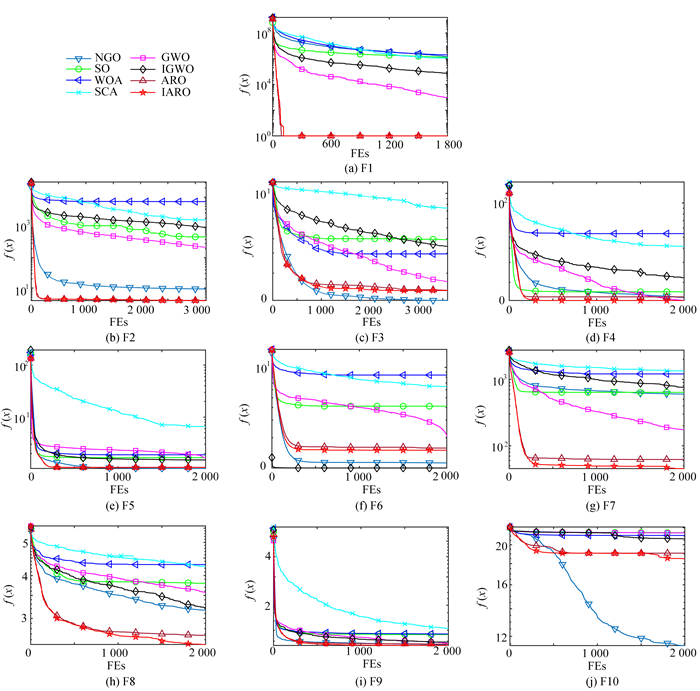
图 2 CEC’2019测试函数收敛图
注 为了解释图中的颜色,读者可以参考本文的电子网页版本,后同.
Figure 2. CEC' 2019 test function convergence diagram

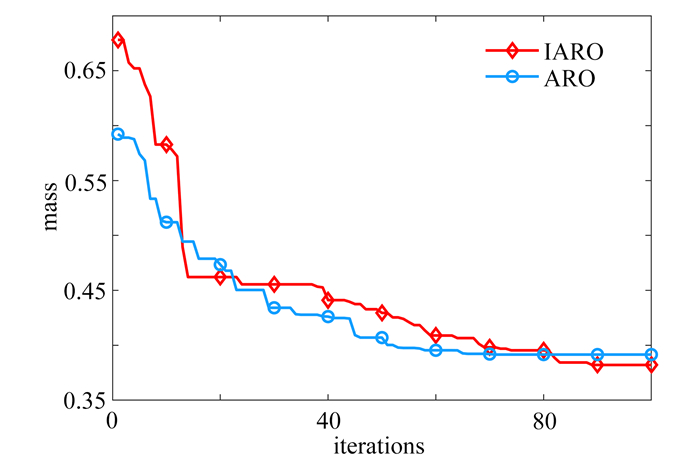
图 6 复杂开孔FG板的迭代曲线
Figure 6. Iteration curves of complex functionally graded plates with holes

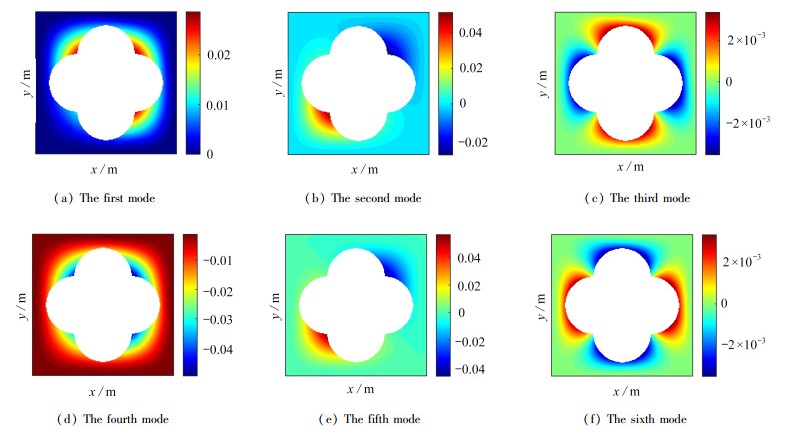
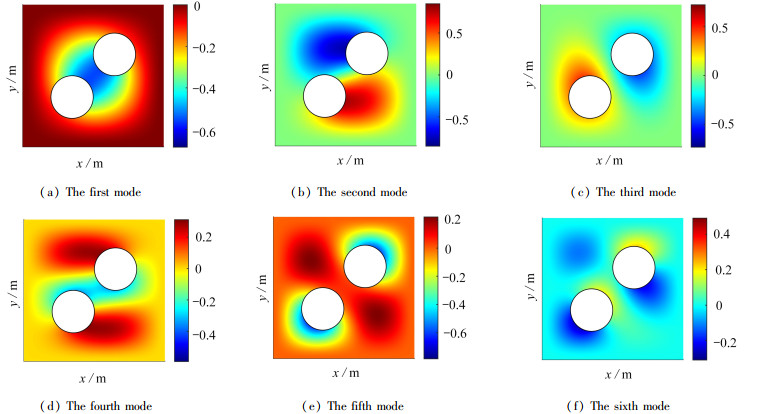
图 10 双孔板最优解的六种自振振型
Figure 10. The six vibration mode shapes of the optimized solutions for two-hole plates

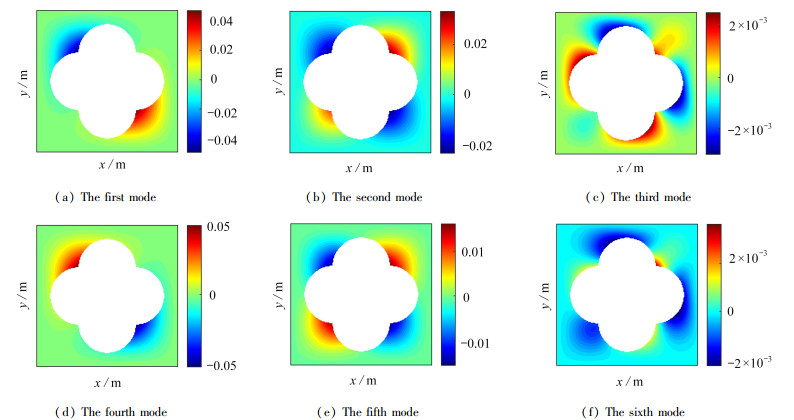
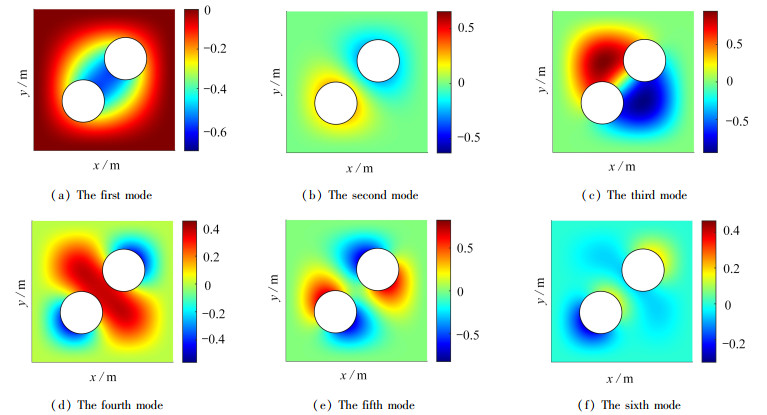
图 11 双孔板最优解的六种屈曲振型
Figure 11. The six buckling mode shapes of the optimized solutions for two-hole plates
表 1 算法参数设置
Table 1. Algorithm parameter settings
algorithm parameter setting NGO I is 0 or 2 SO c1=0.5, c2=0.05, c3=2 GWO a decreasing linearly from 2 to 0 IGWO a decreasing linearly from 2 to 0 AOA α=5, μ=0.5  下载: 导出CSV
表 2 不同优化器在CEC’2019基准上的性能统计
Table 2. Performance statistics of different optimizers on CEC'2019 benchmark
function NGO SO WOA SCA GWO IGWO ARO IARO F1 mean 1.10 1.07E6 2.02E6 1.14E6 9.47E2 7.38E4 1.00 1.00 std 4.06E-1 1.13E6 4.03E6 1.75E6 3.35E3 7.97E4 0.00 0.00 t 2.13E-1 1.92E-5 1.02E-2 1.28E-3 1.40E-1 2.61E-5 NaN NaN Wilcoxon + + + + + + ≈ F2 mean 9.35 4.90E2 7.14E3 1.79E3 2.18E2 1.02E3 3.91 3.85 std 4.82 4.43E2 2.36E3 9.84E2 1.70E2 3.67E2 3.23E-1 3.12E-1 t 1.38E-6 2.07E-6 2.46E-16 7.80E-11 1.98E-7 4.04E-15 5.04E-1 NaN Wilcoxon + + + + + + ≈ F3 mean 1.15 3.93 2.95 7.44 1.69 3.42 1.42 1.41 std 1.94E-1 1.68 1.99 1.59 9.39E-1 1.59 4.06E-2 2.25E-4 t 9.07E-8 6.62E-9 2.09E-4 6.24E-19 1.22E-1 1.68E-7 3.16E-1 NaN Wilcoxon + + + + + + + F4 mean 1.46E1 1.66E1 5.38E1 4.16E1 1.39E1 2.20E1 1.49E1 1.39E1 std 4.09 5.91 1.69E1 7.50 5.61 3.88 5.04 5.46 t 5.74E-1 8.52E-2 4.17E-12 4.63E-18 9.80E-1 5.26E-7 4.40E-1 NaN Wilcoxon - - + + + + + F5 mean 1.03 1.66 1.89 6.60 1.64 1.51 1.09 1.08 std 1.74E-2 7.76E-2 3.75E-1 1.15 6.83E-1 8.53E-2 4.84E-2 4.42E-2 t 1.92E-6 1.50E-26 1.98E-12 1.11E-21 1.06E-4 1.68E-20 6.69E-1 NaN Wilcoxon + + + + + + + F6 mean 1.12 4.12 8.39 6.60 2.08 1.00 1.58 1.50 std 3.34E-1 1.37 1.74 1.15 8.93E-1 5.42E-4 6.37E-1 7.48E-1 t 2.37E-2 1.66E-10 1.07E-17 1.66E-17 2.06E-2 1.12E-3 6.12E-1 NaN Wilcoxon + + + + + - + F7 mean 6.01E2 6.38E2 1.21E3 1.34E3 1.75E2 7.51E2 6.22E1 4.53E1 std 1.58E2 3.42E2 3.00E2 2.05E2 1.40E2 2.42E2 7.48E1 6.55E1 t 5.57E-17 4.59E-10 2.02E-19 1.15E-23 3.29E-4 1.09E-14 3.18E-1 NaN Wilcoxon + + + + + + + F8 mean 3.17 3.80 4.31 4.26 3.57 3.22 2.68 2.52 std 2.90E-1 3.09E-1 4.00E-1 2.33E-1 4.66E-1 3.46E-1 5.21E-1 6.15E-1 t 2.76E-6 6.12E-11 2.15E-13 8.00E-15 3.29E-7 1.26E-5 2.86E-1 NaN Wilcoxon + + + + + + + F9 mean 1.13 1.32 1.33 1.43 1.15 1.18 1.15 1.13 std 3.52E-2 9.36E-2 1.41E-1 1.10E-1 5.96E-2 3.30E-2 7.26E-2 4.88E-2 t 8.44E-1 3.73E-11 6.62E-8 9.47E-16 1.42E-1 1.46E-4 1.94E-1 NaN Wilcoxon - + + + + + + F10 mean 1.14E1 2.14E1 2.11E1 2.14E1 2.14E1 2.07E1 1.91E1 1.85E1 std 9.57 9.93E-2 8.64E-2 5.68E-2 5.81E-2 3.58 5.76 6.39 t 2.20E-3 2.12E-2 3.82E-2 2.21E-2 2.16E-2 1.32E-1 7.32E-1 NaN Wilcoxon - + + + + + + +/-/≈/gm 62/6/2/60
下载: 导出CSV
表 3 第一自然频率对比统计表(单位: rad/s)
Table 3. Comparison of the critical buckling stresses(unit: rad/s)
下载: 导出CSV
-
[1] 仲政, 吴林志, 陈伟球. 功能梯度材料与结构的若干力学问题研究进展[J]. 力学进展, 2010, 40(5): 528-541.ZHONG Zheng, WU Linzhi, CHEN Weiqiu. Progress in the study on mechanics problems of functionally graded materials and structures[J]. Advances in Mechanics, 2010, 40(5): 528-541. (in Chinese) [2] SOBCZAK J J, DRENCHEV L. Metallic functionally graded materials: a specific class of advanced composites[J]. Journal of Materials Science & Technology, 2013, 29(4): 297-316. [3] NAEBE M, SHIRVANIMOGHADDAM K. Functionally graded materials: a review of fabrication and properties[J]. Applied Materials Today, 2016, 5: 223-245. doi: 10.1016/j.apmt.2016.10.001 [4] 舒小平. 功能梯度压电材料壳体热残余应力[J]. 机械强度, 2012, 34(1): 69-76.SHU Xiaoping. Thermal residual stresses of functionally graded piezoelectric shells[J]. Journal of Mechanical Strength, 2012, 34(1): 69-76. (in Chinese) [5] 李世荣, 范亮亮. 热环境中功能梯度材料圆板的自由振动[J]. 振动工程学报, 2007, 20(4): 353-360.LI Shirong, FAN Liangliang. Free vibration of functionally graded circular plates in thermal environment[J]. Journal of Vibration Engineering, 2007, 20(4): 353-360. (in Chinese) [6] 尹硕辉, 余天堂, 刘鹏. 基于等几何有限元法的功能梯度板自由振动分析[J]. 振动与冲击, 2013, 32(24): 180-186.YIN Shuohui, YU Tiantang, LIU Peng. Free vibration analysis of functionally graded plates using isogeometric finite element method[J]. Journal of Vibration and Shock, 2013, 32(24): 180-186. (in Chinese) [7] ENDO M, KIMURA N. An alternative formulation of the boundary value problem for the Timoshenko beam and Mindlin plate[J]. Journal of Sound and Vibration, 2007, 301(1/2): 355-373. [8] 陈卫, 汤智宏, 彭林欣. 基于分层法的功能梯度三明治壳线性弯曲无网格分析[J]. 应用数学和力学, 2024, 45(5): 539-553. doi: 10.21656/1000-0887.440262CHEN Wei, TANG Zhihong, PENG Linxin. Linear bending analysis of functionally graded sandwich shells with the meshless method based on the layer-wise theory[J]. Applied Mathematics and Mechanics, 2024, 45(5): 539-553. (in Chinese) doi: 10.21656/1000-0887.440262 [9] MANTARI J L, OKTEM A S, SOARES C G. Bending response of functionally graded plates by using a new higher order shear deformation theory[J]. Composite Structures, 2012, 94(2): 714-723. doi: 10.1016/j.compstruct.2011.09.007 [10] Rabhi M, Benrahou K H, Kaci A, et al. A new innovative 3-unknowns HSDT for buckling and free vibration of exponentially graded sandwich plates resting on elastic foundations under various boundary conditions[J]. Geomechanics and Engineering, 2020, 22(2): 119-132. [11] HUGHES T J R, COTTRELL J A, BAZILEVS Y. Isogeometric analysis: CAD, finite elements, NURBS, exact geometry and mesh refinement[J]. Computer Methods in Applied Mechanics and Engineering, 2005, 194(39/40/41): 4135-4195. [12] 祝雪峰, 胡平, 马正东, 等. 基于FETI的非协调等几何分析[J]. 应用数学和力学, 2013, 34(8): 771-781. doi: 10.3879/j.issn.1000-0887.2013.08.001ZHU Xuefeng, HU Ping, MA Zhengdong, et al. Nonconforming isogeometric analysis with FETI method[J]. Applied Mathematics and Mechanics, 2013, 34(8): 771-781. (in Chinese) doi: 10.3879/j.issn.1000-0887.2013.08.001 [13] 刘石, 陈德祥, 冯永新, 等. 等几何分析的多重网格共轭梯度法[J]. 应用数学和力学, 2014, 35(6): 630-639. doi: 10.3879/j.issn.1000-0887.2014.06.005LIU Shi, CHEN Dexiang, FENG Yongxin, et al. A multigrid preconditioned conjugate gradient method for isogeometric analysis[J]. Applied Mathematics and Mechanics, 2014, 35(6): 630-639. (in Chinese) doi: 10.3879/j.issn.1000-0887.2014.06.005 [14] 孙少灰, 尹硕辉. 基于等几何边界元法和粒子群优化算法的结构形状优化[J]. 机械强度, 2019, 41(2): 363-368.SUN Shaohui, YIN Shuohui. Structural shape optimization by isogeometric boundary element method[J]. Journal of Mechanical Strength, 2019, 41(2): 363-368. (in Chinese) [15] 陈涛, 莫蓉, 万能, 等. 等几何分析中采用Nitsche法施加位移边界条件[J]. 力学学报, 2012, 44(2): 369-381.CHEN Tao, MO Rong, WAN Neng, et al. Imposing displacement boundary conditions with Nitsche's method in isogeometric analysis[J]. Chinese Journal of Theoretical and Applied Mechanics, 2012, 44(2): 369-381. (in Chinese) [16] 刘硕. 基于等几何分析的层合微板弯曲、振动和屈曲行为研究[D]. 哈尔滨: 哈尔滨工业大学, 2022.LIU Shuo. Research on bending, vibration and buckling of laminate micro-plate based on isogeometric analysis[D]. Harbin: Harbin Institute of Technology, 2022. (in Chinese) [17] 陈明飞, 刘坤鹏, 靳国永, 等. 面内功能梯度三角形板等几何面内振动分析[J]. 应用数学和力学, 2020, 41(2): 156-170. doi: 10.21656/1000-0887.400171CHEN Mingfei, LIU Kunpeng, JIN Guoyong, et al. Isogeometric in-plane vibration analysis of functionally graded triangular plates[J]. Applied Mathematics and Mechanics, 2020, 41(2): 156-170. (in Chinese) doi: 10.21656/1000-0887.400171 [18] GOUPEE A J, VEL S S. Two-dimensional optimization of material composition of functionally graded materials using meshless analyses and a genetic algorithm[J]. Computer Methods in Applied Mechanics and Engineering, 2006, 195(44/45/46/47): 5926-5948. [19] 李信卿, 赵清海, 张洪信, 等. 周期性功能梯度结构稳态热传导拓扑优化设计[J]. 中国机械工程, 2021, 32(19): 2348-2356.LI Xinqing, ZHAO Qinghai, ZHANG Hongxin, et al. Steady-state heat conduction topology optimization design for periodic functional gradient structures[J]. China Mechanical Engineering, 2021, 32(19): 2348-2356. (in Chinese) [20] FRANCO CORREIA V M, AGUILAR MADEIRA J F, ARAÚJO A L, et al. Multiobjective optimization of ceramic-metal functionally graded plates using a higher order model[J]. Composite Structures, 2018, 183: 146-160. doi: 10.1016/j.compstruct.2017.02.013 [21] ABOLGHASEMI S, SHATERZADEH A R, REZAEI R. Thermo-mechanical buckling analysis of functionally graded plates with an elliptic cutout[J]. Aerospace Science and Technology, 2014, 39: 250-259. doi: 10.1016/j.ast.2014.10.004 [22] MIRZAEI M, KIANI Y. Free vibration of functionally graded carbon-nanotube-reinforced composite plates with cutout[J]. Beilstein Journal of Nanotechnology, 2016, 7: 511-523. doi: 10.3762/bjnano.7.45 [23] TRAN L V, FERREIRA A J M, NGUYEN-XUAN H. Isogeometric analysis of functionally graded plates using higher-order shear deformation theory[J]. Composites Part B: Engineering, 2013, 51: 368-383. doi: 10.1016/j.compositesb.2013.02.045 [24] ZENKOUR A M. A comprehensive analysis of functionally graded sandwich plates: part 1: deflection and stresses[J]. International Journal of Solids and Structures, 2005, 42(18/19): 5224-5242. [25] BENSON D J, BAZILEVS Y, DE LUYCKER E, et al. A generalized finite element formulation for arbitrary basis functions: from isogeometric analysis to XFEM[J]. International Journal for Numerical Methods in Engineering, 2010, 83(6): 765-785. doi: 10.1002/nme.2864 [26] WANG C, YU T, SHAO G, et al. Shape optimization of structures with cutouts by an efficient approach based on XIGA and chaotic particle swarm optimization[J]. European Journal of Mechanics-A/Solids, 2019, 74: 176-187. doi: 10.1016/j.euromechsol.2018.11.009 [27] WANG L, CAO Q, ZHANG Z, et al. Artificialrabbits optimization: a new bio-inspired meta-heuristic algorithm for solving engineering optimization problems[J]. Engineering Applications of Artificial Intelligence, 2022, 114: 105082. doi: 10.1016/j.engappai.2022.105082 [28] BARTHELEMY P, BERTOLOTTI J, WIERSMA D S. Alévy flight for light[J]. Nature, 2008, 453(7194): 495-498. doi: 10.1038/nature06948 [29] DEHGHANI M, HUBÁLOVSKÝ Š, TROJOVSKÝ P. Northern goshawk optimization: a new swarm-based algorithm for solving optimization problems[J]. IEEE Access, 2021, 9: 162059-162080. doi: 10.1109/ACCESS.2021.3133286 [30] HASHIM F A, HUSSIEN A G. Snake optimizer: a novel meta-heuristic optimization algorithm[J]. Knowledge-Based Systems, 2022, 242: 108320. doi: 10.1016/j.knosys.2022.108320 [31] MIRJALILI S, LEWIS A. The whale optimization algorithm[J]. Advances in Engineering Software, 2016, 95: 51-67. doi: 10.1016/j.advengsoft.2016.01.008 [32] MIRJALILI S. SCA: a sine cosine algorithm for solving optimization problems[J]. Knowledge-Based Systems, 2016, 96: 120-133. doi: 10.1016/j.knosys.2015.12.022 [33] MIRJALILI S, MIRJALILI S M, LEWIS A. Grey wolf optimizer[J]. Advances in Engineering Software, 2014, 69: 46-61. doi: 10.1016/j.advengsoft.2013.12.007 [34] NADIMI-SHAHRAKI M H, TAGHIAN S, MIRJALILI S. An improved grey wolf optimizer for solving engineering problems[J]. Expert Systems With Applications, 2021, 166: 113917. doi: 10.1016/j.eswa.2020.113917 [35] YIN S, HALE J S, YU T, et al. Isogeometric locking-free plate element: a simple first order shear deformation theory for functionally graded plates[J]. Composite Structures, 2014, 118: 121-138. doi: 10.1016/j.compstruct.2014.07.028 [36] SHOJAEE S, IZADPANAH E, VALIZADEH N, et al. Free vibration analysis of thin plates by using a NURBS-based isogeometric approach[J]. Finite Elements in Analysis and Design, 2012, 61: 23-34. doi: 10.1016/j.finel.2012.06.005 [37] CUI X Y, LIU G R, LI G Y, et al. A thin plate formulation without rotation DOFs based on the radial point interpolation method and triangular cells[J]. International Journal for Numerical Methods in Engineering, 2011, 85(8): 958-986. doi: 10.1002/nme.3000 [38] ZHAO X, LEE Y Y, LIEW K M. Mechanical and thermal buckling analysis of functionally graded plates[J]. Composite Structures, 2009, 90(2): 161-171. doi: 10.1016/j.compstruct.2009.03.005 [39] YIN S, YU T, BUI T Q, et al. Buckling and vibration extended isogeometric analysis of imperfect graded Reissner-Mindlin plates with internal defects using NURBS and level sets[J]. Computers and Structures, 2016, 177(C): 23-38. [40] 汪超, 刘涛, 辜继明, 等. 基于XIGA的开孔功能梯度板材料分布多目标优化[J]. 机械强度, 2021, 43(5): 1095-1103.WANG Chao, LIU Tao, GU Jiming, et al. Multi-objective optimization of material distribution for functionally grade plates with cutouts based on XIGA[J]. Journal of Mechanical Strength, 2021, 43(5): 1095-1103. (in Chinese) -

计量
- 文章访问数: 62
- HTML全文浏览量: 14
- PDF下载量: 14
- 被引次数: 0

 渝公网安备50010802005915号